
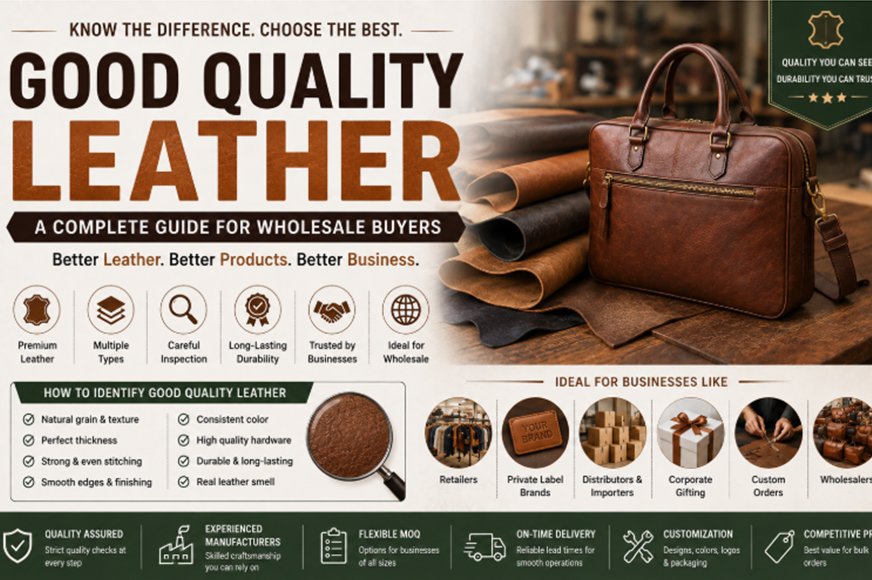
When buying leather bags in bulk, one of the most important decisions is choosing the right leather quality. The material affects the bag’s appearance, durability, texture, performance, and overall value. For retailers, private-label brands, distributors, and corporate buyers, understanding how to identify good quality leather can make a significant difference when selecting a manufacturing or sourcing partner.
With so many leather products available in the market, it can be difficult to distinguish between different leather types and finishes simply by looking at a product photograph. Buyers should understand the material, construction, finishing, and manufacturing standards before placing a wholesale order.
This guide explains how businesses can evaluate leather quality and make more informed purchasing decisions.
What Does Good Quality Leather Mean?
The term “good quality leather” generally refers to leather that has suitable characteristics for its intended application, including durability, appearance, consistency, texture, and appropriate finishing.
However, leather quality is not determined by one factor alone. Different types of leather can be suitable for different products.
For example, a luxury handbag may require a soft and premium-looking leather, while a work bag may prioritize durability and structure.
Therefore, B2B buyers should focus on whether the leather is appropriate for the product and target market rather than assuming that one type is always better than another.
What Are the Main Types of Leather?
Before evaluating leather quality, buyers should understand the major categories commonly used in bag manufacturing.
Full-Grain Leather
Full-grain leather retains the natural grain of the hide and is generally valued for its durability and natural appearance. Because the surface retains more of the original grain, natural marks and variations may be visible.
For premium products, these natural characteristics can contribute to the unique appearance of each bag.
Top-Grain Leather
Top-grain leather has been processed to create a more uniform surface while retaining a substantial portion of the natural leather structure.
It can provide a balance between appearance, consistency, and durability, making it suitable for various fashion and business products.
Corrected-Grain Leather
Corrected-grain leather is processed to create a more consistent surface. It may be embossed or finished to achieve a particular appearance.
This type of leather can be useful when businesses require consistent textures and finishes across larger production quantities.
Genuine Leather
“Genuine leather” is a broad commercial term and does not automatically mean that a product is premium quality.
B2B buyers should therefore ask suppliers for more specific information about the leather type, finish, thickness, and manufacturing process instead of relying only on the phrase “genuine leather.”
How to Identify Good Quality Leather
One of the easiest ways to evaluate leather is to examine several characteristics rather than relying on a single visual feature.
1. Check the Surface
Natural leather may have subtle variations, grain patterns, or small imperfections.
A completely uniform surface is not necessarily an indication of higher quality because some leather products are processed or embossed for consistency.
Look closely at the surface and ask the manufacturer whether the texture is natural, embossed, coated, or otherwise finished.
2. Examine the Texture
The feel of the leather can provide useful information.
High-quality leather suitable for premium bags often has a consistent and appropriate texture without feeling excessively plastic-like.
However, texture varies according to the leather type and finishing process, so buyers should compare samples rather than making decisions based only on touch.
3. Check the Thickness
Leather thickness can influence the structure and performance of a bag.
A structured briefcase may require different leather thickness than a soft handbag or lightweight tote.
Ask the manufacturer for the leather thickness or specifications before approving bulk production.
4. Look at the Edges
The edges of a leather bag can reveal a lot about manufacturing quality.
Check whether the edges are:
- Smoothly finished
- Properly painted or burnished
- Evenly cut
- Free from excessive roughness
- Consistent throughout the product
Good leather combined with poor edge finishing can still result in an inferior-looking product.
5. Inspect the Stitching
Leather quality is only one part of a well-made bag.
The stitching should also be evaluated. Look for consistent stitch spacing, secure thread ends, straight seams, and reinforced areas where necessary.
For wholesale orders, consistency across multiple samples is particularly important.
6. Check Hardware Quality
Zippers, buckles, rings, clasps, and other hardware contribute significantly to the overall performance of a leather bag.
Before placing a bulk order, check whether the hardware operates smoothly and whether its finish matches the intended product design.
A premium-looking leather bag with weak or poorly finished hardware can reduce the perceived value of the product.
Why Leather Quality Matters for B2B Buyers
For retailers and brands, choosing good quality leather can influence customer satisfaction and product positioning.
A well-selected material can help a business create products that match its intended price range and target audience.
For example:
Luxury brands may prioritize premium finishes and distinctive natural textures.
Corporate suppliers may prioritize durability, professional appearance, and functionality.
Retailers may focus on a balance between appearance, durability, and cost.
Private-label brands may prioritize consistent material quality across multiple production runs.
Understanding these differences allows buyers to select leather based on actual business requirements.
How to Check Leather Quality Before a Wholesale Order
Never rely entirely on photographs when placing a large leather bag order.
A practical B2B sourcing process should include sample evaluation.
Request a Sample
Ask the manufacturer to provide a physical sample before approving bulk production whenever possible.
Evaluate:
- Leather texture
- Thickness
- Color consistency
- Stitching
- Hardware
- Lining
- Compartments
- Edges
- Logo placement
- Overall construction
Ask for Material Details
A professional supplier should be able to provide useful information about the leather being used.
Ask about:
- Leather type
- Leather thickness
- Finish
- Origin, where relevant
- Available colors
- Treatment or coating
- Quality standards
Clear specifications reduce misunderstandings between buyers and manufacturers
Good Quality Leather vs. Cheap Leather
Price alone should not determine your purchasing decision.
Cheap leather may reduce the initial purchase cost, but it may also affect the perceived quality, durability, and customer experience of the finished product.
At the same time, the most expensive leather is not automatically the best choice for every business.
The right approach is to identify the material that provides an appropriate balance between quality, performance, appearance, and target selling price.
This is particularly important for wholesale lather buyers who need to maintain margins while delivering products that meet customer expectations.
How to Choose a Wholesale Leather Bag Supplier
When sourcing leather bags for a business, evaluate the supplier as carefully as the product itself.
Look for a supplier or manufacturer that offers:
- Clear product specifications
- Consistent material quality
- Customization capabilities
- Reliable communication
- Sample development
- Quality-control processes
- Suitable minimum order quantities
- Transparent pricing
- Realistic production timelines
- Packaging options
For international buyers, it can also be useful to understand shipping, documentation, payment terms, and export capabilities before confirming a large order.
Questions to Ask a Leather Bag Manufacturer
Before placing an order, B2B buyers can ask:
- What type of leather is used?
- What is the leather thickness?
- Is the leather natural, corrected, or embossed?
- Can you provide a physical sample?
- What is the minimum order quantity?
- Can the design be customized?
- Can you add private-label branding?
- What quality checks are performed?
- What is the estimated production timeline?
- What packaging options are available?
These questions can help buyers compare suppliers more objectively.
Why India Is an Important Leather Bag Sourcing Market
India has a long-established leather and footwear manufacturing industry, with production clusters and businesses involved in leather processing, accessories, footwear, and leather goods.
For B2B buyers, sourcing from India can provide opportunities for wholesale production, customized manufacturing, private-label products, and export-oriented orders.
However, buyers should still evaluate individual manufacturers based on product quality, production capabilities, communication, compliance, and reliability rather than selecting a supplier solely because of location.
Questions: Good-Quality Leather
Check the leather’s type, texture, thickness, finish, surface characteristics, stitching, edges, and overall construction. For B2B purchases, always request samples and material specifications before confirming bulk production.
There is no single leather type that is best for every bag. Full-grain, top-grain, corrected-grain, and other leather types can be suitable depending on the design, durability requirements, price point, and target customer.
Check the leather specifications, product construction, stitching, hardware, lining, dimensions, customization options, MOQ, sample quality, pricing, and production timeline.
Not necessarily. The best material depends on the intended product, target market, design, performance requirements, and budget. Buyers should compare quality against the specific requirements of their business.
Yes. A physical sample can help you evaluate the actual material, construction, color, finishing, dimensions, and branding before committing to a larger production quantity.
Final Thoughts
Choosing good quality leather is an important part of successful B2B leather bag sourcing. Buyers should look beyond price and evaluate the material, construction, finishing, hardware, stitching, and consistency of the final product.
For wholesale and private-label businesses, working with an experienced supplier can make the sourcing process easier. Clear specifications, physical samples, quality checks, and transparent communication can help reduce production issues and improve consistency.
Whether you are a retailer, distributor, corporate buyer, private-label brand, or international importer, taking the time to understand leather quality can help you select products that match your customers’ expectations and business goals.
When comparing suppliers, remember that good quality leather should always be evaluated in relation to the product’s intended use, target market, price range, and required performance.
For businesses looking for reliable sourcing, an experienced leather bag manufacturer can provide guidance on suitable materials, designs, customization, production, and bulk requirements.
Disclaimer: Leather quality, terminology, grades, finishes, and manufacturing practices can vary between suppliers and markets. Buyers should verify material specifications, samples, certifications, and commercial terms directly with the manufacturer before placing a wholesale order.
Leave a Reply